If you are frantically searching for a reliable Veo watermark remover to clean up your AI-generated footage, you are in the exact same boat I was a few weeks ago.
Google Veo (including the latest Veo 3) has completely revolutionized my video production workflow. The hyper-realistic textures and cinematic lighting it generates are mind-blowing. However, there is a massive roadblock: that distracting Google Veo logo and SynthID artifact stamped right in the corner of every single output.
When you are trying to produce a cinematic masterpiece or a high-converting ad, a native watermark breaks the fourth wall. It immediately screams “AI-generated stock footage,” which destroys viewer immersion and can even trigger social media algorithms to downrank your work.
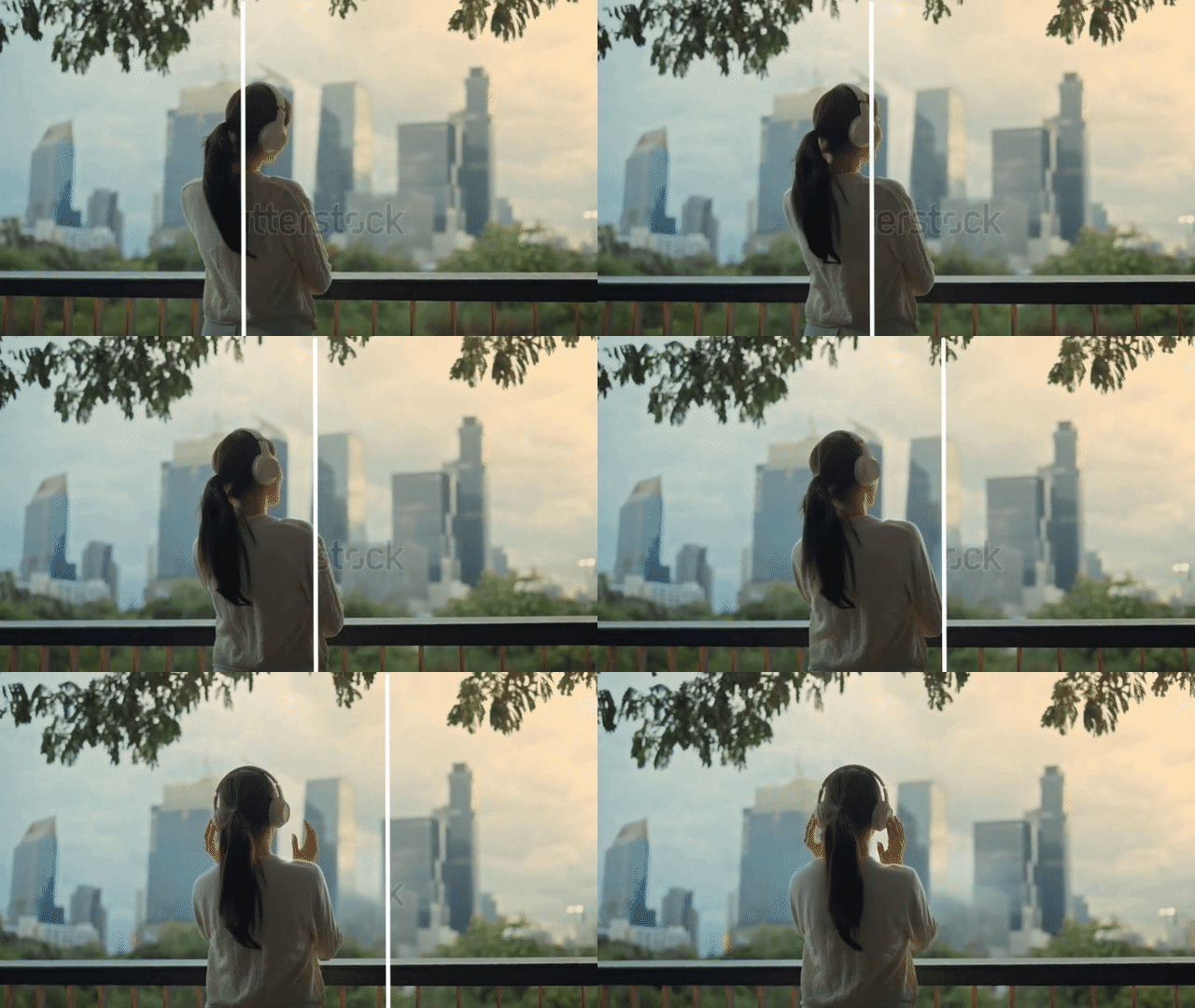
I tested dozens of basic editors, and almost all of them ruined my ultra-realistic 4K footage by leaving an ugly, blurry smudge. Finally, I found a specialized web-based AI tool that actually rebuilds the pixels. Here is a deep dive into why generic editors destroy Veo videos, and how I use this specific tool to get flawless, unbranded assets instantly.
Why Cleaning Your Veo Footage is Mandatory
A watermark isn’t just annoying to look at; it actively limits how you can commercialize your Veo outputs. Here is why stripping the AI branding is essential for forward-thinking creators:
- For AI Filmmakers & Digital Artists: When directing AI cinematic films, commercial trailers, or conceptual art, you need full creative direction. Removing the tech logo allows you to broadcast a cohesive visual masterpiece.
- For Social Media Marketers: Want to repurpose your photorealistic clips into viral Instagram Reels, TikToks, or YouTube Shorts? Removing the watermark prevents platform recommendation algorithms from flagging and downranking your work as branded or generic AI content.
- For Advertising Agencies: You cannot use watermarked background B-rolls for high-converting landing pages or social media ad campaigns. Erasing the default watermark transforms raw model generations into premium, enterprise-ready brand assets.
Why Basic Blur Apps Destroy Veo Videos (And How AI Fixes It)
Google Veo delivers cinematic 1080p and 4K outputs. Using a substandard watermark remover on these files will ruin their groundbreaking visual fidelity. Here are the three main technical challenges of cleaning Veo videos, and why I only trust advanced AI inpainting:
❌ Pain Point 1: Ruining Ultra-Realistic Textures
Google Veo is celebrated for its incredible rendering of hyper-realistic skin textures, moving water, and complex cloud formations. Standard watermark removers use basic cloning algorithms that create a blurry, smudged patch, completely giving away that the video was edited.
- The AI Solution: Context-Aware Micro-Texture Filling. The advanced AI doesn’t just blur the spot; it actively reconstructs the hidden high-frequency details—like individual hairs, mist, or stone grains—making the deletion 100% invisible.
❌ Pain Point 2: Disrupted Complex Lighting and Volumetric Smoke
Veo videos excel at simulating cinema-grade lighting, volumetric fog, and complex reflections. Traditional tools leave behind severe ghosting artifacts or flickering boxes because they cannot calculate how light and smoke dynamically shift behind a stationary logo.
- The AI Solution: Spatial-Temporal Neural Inpainting. By utilizing multi-frame fusion, the AI tracks the lighting vectors and fluid movements across consecutive frames. It intelligently fills the watermark zone by carrying over the real-time illumination and smoke physics.
❌ Pain Point 3: Heavy Compression and Severe Quality Drop
Many online downloaders aggressively re-encode the video file upon export. This drastically drops the high bitrate natively outputted by Google Veo, turning a stunning 4K piece into a compressed, low-fidelity asset.
- The AI Solution: Lossless Direct Bitrate Export. The technology performs localized processing strictly restricted to the watermark boundary box. The rest of the AI-generated frame is completely untouched, retaining the full resolution and native bitrate.
My 3-Step Workflow to Remove Veo Watermarks Instantly
You don’t need to install any heavy software to achieve these studio-grade finishes. Here is how I transform my raw Google Veo generations into ready-to-publish footage:
Step 1: Upload Your Veo Asset
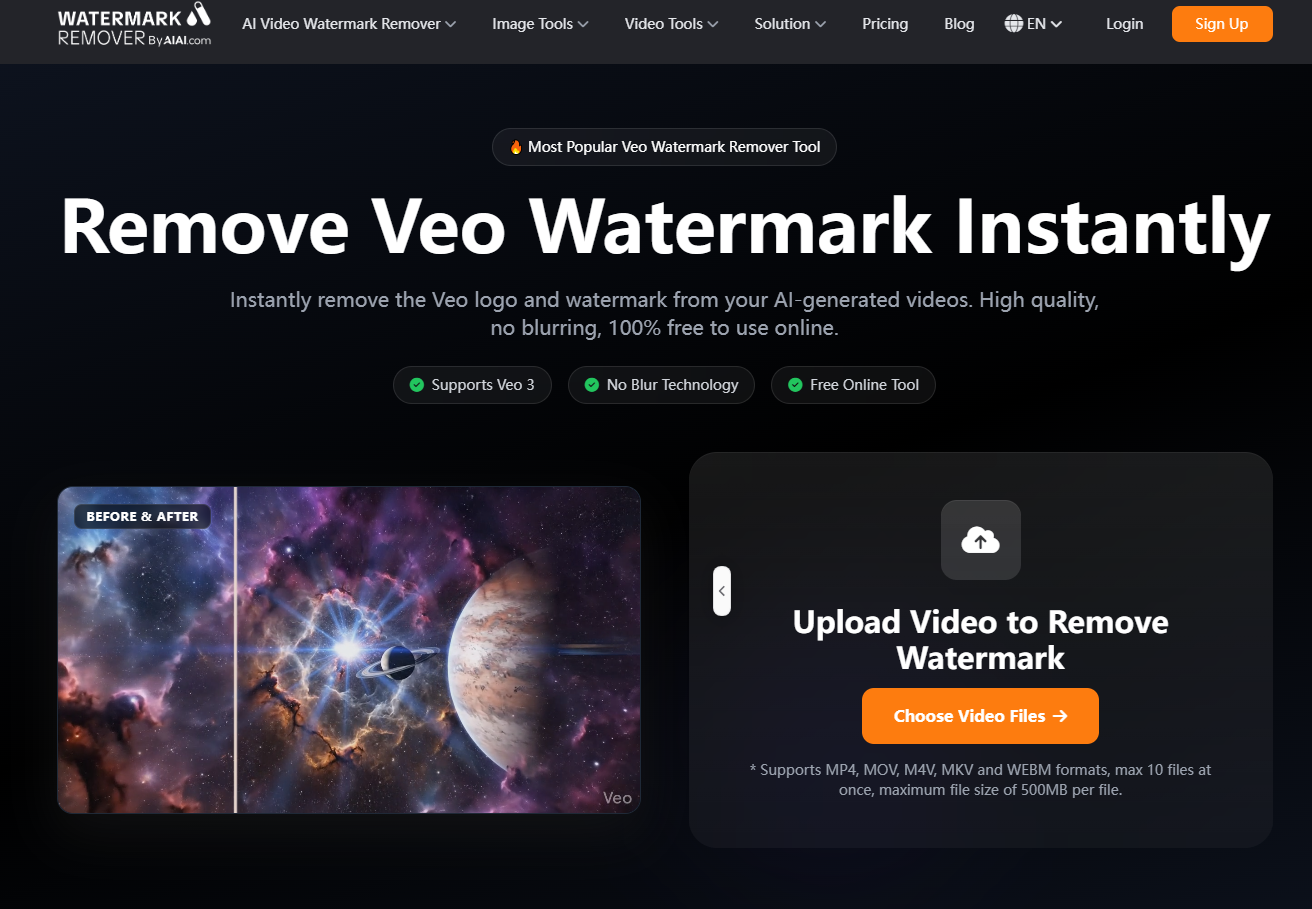
Drag and drop your generated Google Veo video file into the web interface. It supports secure, uncompressed large file uploads (MP4, MOV, M4V, MKV, and WEBM up to 500MB). Pro tip: It supports batch processing up to 10 files at once!
Step 2: Target the AI Branding
Use the smart bounding box tool to cleanly highlight the default watermark or text overlay located on the corner of your video.
Step 3: Process with Advanced AI
Click “Remove Watermark.” The spatial-temporal neural network will recreate the hidden cinematic textures flawlessly. Preview the result and download your unbranded video with zero quality loss.
What Other Creators Are Saying
Don’t just take my word for it. Here is why other professionals rely on this exact tool for their daily edits:
“Finally a tool that actually works on Veo videos! The watermark is completely gone and the quality is still perfect.”— Sarah J., Content Creator
“I used this to clean up some AI generated clips for my presentation. Saved me hours of editing time. Highly recommend!”— Mike T., Marketing Manager
“Best free watermark remover I’ve found. It handles the new Veo watermarks perfectly.”— David L., Video Editor
Fast, Free, and 100% Private
As creators, we care about the security of our unreleased projects. The best part about this specific Veo watermark remover is that it guarantees 100% privacy. Your videos are processed securely and deleted automatically right after processing.
Plus, there is no waiting time. You can try the AI watermark removal instantly for free—no credit card required.
Stop letting a tech logo break the fourth wall of your cinematic masterpiece. Clean your Veo videos today.
[Click Here to Try the Veo Watermark Remover for Free]